Knockaderry House
Newcastle West , Co. Limerick

An Irish Pilot (Lady Heath) 1928
Oil on Canvas
76.2 x 63.6 cm
Lady Lavery Memorial Bequest through Sir John Lavery,
1935
The lady depicted in this portrait had an enigmatic smile,
however behind this demure face is a confusing and dramatic story. Confusion arises as to whether this is actually a portrait of Lady Mary Heath, Ireland's
first female aviator. Lady Heath, like her Limerick home, has become over looked and forgotten. This lady, born Sophie Peirce-Evans led an unhappy and unsettled life having married
three times and lived in numerous locations around the world. One of her marriages was to an elderly man and Mary made no
qualms that she was marrying him in order to have access to his money. Numerous successes in her flying career had her aeronautical exploits making front
page news around the world, yet she died destitute at a relatively young age. Little did thousands
of spectators know at the 1928 Amsterdam Olympics when they craned their necks
to admire the aerobatic display above their heads, that the pilot had shaken
off the limitations of being a woman and Irish, in an age when both
were seen as obstacles in the new world of aviation. She was the first woman to
get a commercial pilot’s licence, to parachute and fly from Cape Town to
London.

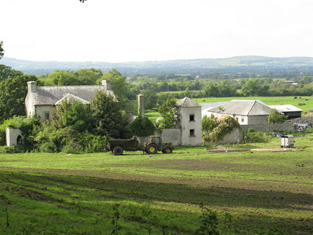
Knockaderry House the home of Lady Mary where she was born and also the place where her father murdered her mother in the mid 1890's.

A view of the side of Knockaderry
House which was formed the centre of the Peirce Evans Estate
( Copyright John Cussen, Newcastle
West, Limerick)
The painting by Sir John Lavery, now in the possession of the Hugh Lane Gallery in Dublin, has many titles and arguments abound of who is actually depicted in the painting. Bearing in mind that Lavery gave the painting the title of 'Ireland’s First Air Woman', it must surely be Sophia Theresa Catherine Mary Peirce-Evans. She was born on November 17th 1896 at Knockaderry House near Newcastle West in Limerick. Knockaderry was surrounded by a farm of 350 acres which was owned by Sophie’s father John Peirce-Evans. Her childhood was not to be a peaceful one as her father was found guilty in 1897 of murdering his wife, whom he bludgeoned to death with a stick in the house. They had only been married two years and John's history of mental illness caused him to carry out unspeakable acts of violence on his wife, Kate Theresa Dooling from North Kerry. She had been previously married to a solider in Tralee, where she had been employed as a servant in the house of a shop keeper in Castle St. Tralee. After the death of her first husband, she moved to Limerick where she was employed as a servant by John Peirce Evans. The marriage did not bring John happiness and neither did the large estate that he inherited from his uncle, Thomas D'Arcy Evans. John's abysmal management of his finances resulted in the Court of Chancery taken control of his property from which they provided him with an annuity. A few months before he murdered his wife, he left Limerick and traveled to Cork with his infant daughter. He kept the child in a trunk and was returned to Limerick when a lady in a lodging house became concerned with his treatment of his child and called the police. When Kate's body was discovered by local member of the RIC in the kitchen of Knockaderry House in 1897, the victim’s young infant daughter was found to be sleeping nearby. Scattered on the floor was a bent iron fire tongs and a broken hazel stick. John was sent to mental asylum in Dublin where he died in 1916 while his infant daughter was sent to live with out to her two maiden aunts in the nearby town of Newcastle West. Knockaderry House was a simple farm house with delusions of grandeur, some of it features trying to emulate a grander country mansion. It is a two story over basement house built in the 1780’s and was the ancient seat of the D'Arcy family in the area. It appears that the house always had an eventful history, in 1822, when Knockaderry was the then home of JD Evans, it was attacked by 20 men. They tried to enter the house by removing the window cill of the parlour. However the dogs of the house were alerted and roused the servants. The men trying to enter the house were discovered and soon dispersed. In 1837 the house was the home of Thomas Evans D'Arcy who married in 1814 the second daughter of Richard Taylour of Holly Park, in Limerick but they had no children. Thomas had assumed the additional surname of D'Arcy when he inherited the fortune of his maternal uncle Colonel James D'Arcy. When Thomas died in 1833, he was succeeded by his brother James who in turn bequeathed Knockaderry to Sophie's father.

A damaged and faded photograph of
Knockaderry House but it is interesting as you can see the main features of the
front elevation.
( Copyright John Cussen, Newcastle
West, Limerick)

A map illustrating Knockaderry House
and its outbuildings
( Copyright OSI)

Here can be seen the entrance porch
of Knockaderry House, which has round headed windows with stained glass. Also
noticeable are the large statues found on either side of the front door.
( Copyright John Cussen, Newcastle
West, Limerick)
At the time of the 1901 census, Knockaderry was empty and it is noted that it is still in the hands of the Court of Chancery. In May 1904, Thomas Hannon took out a lease on Knockaderry House and 56 acres of the land that surrounds it. By 1907 the Hannon family had purchased the house for £502 under the Land Purchase Act. In 1908, it was reported in the local press that the sale of the lands of the Evans estate at Knockaderry were being sold to its former tenants. In the 1911 census there was a Hannon family living in a sixteen roomed house in Knockaderry which must have been Knockaderry House. It was during her teenage years that Sophia Peirce-Evans adventurous spirit began to develop. However her life at this time had the appearance of taking a more sedate path, as it looked like she was bound for a life in agricultural science. A marriage at a young age to a British army officer Elliott Lynn in 1916 propelled her in a new direction.


On the left is an image of the painting by Sir John Lavery, painted in 1919. On the right is an
image of Sophie in her uniform during the same period when she drove ambulances during the
First World War.
( Copyright John Cussen, Newcastle
West, Limerick)
I am of the opinion that Sophie was the subject of two Lavery portraits, one painted in 1919 and one painted in 1928. The first portrait by Lavery was painted when Sophie
was in France in July 1919. Lavery was
commissioned to paint a series of paintings for the Imperial War Museum to
record the involvement of women in the First World War. Sophie was a
member of the transport unit who drove ambulances at this time. This Lavery Portrait
eventually passed to Cis Pierce who lived in Ballybunion and the painting now resides in a
well-guarded private collection. However without closer examination of
the two portraits no one can be sure that the portrait is the one that was
painted by Lavery in 1919 or that Lavery didn’t paint a second portrait of
Sophie when she garnered international attention in 1928. The painting by
Lavery which is in the collection of the Dublin City Gallery, the Hugh Lane Gallery which was painted in 1928, does confusingly have the names Lady Heath and Lady Drogheda inscribed on the
back. Some say the Hugh Lane portrait is actually a painting of John Lavery's
daughter Eileen who was also a pilot but one wonders would he have entitled
this portrait ‘The First Irish Airwoman’. The 1928 Lavery painting was painted
in the same year when Lady Heath made front page news as the first female
pilot ever to fly from Cape Town to London. The
painting by Lavery that hangs in gallery in Dublin, may or may not be Lady
Heath however when the painting was examined by conservators it was found to
have been painted over a different composition. It is hoped that this picture
will be x-rayed in the near future proving that this work of art has not given
up all its secrets.


On the left is an image of the portrait of Lady Mary Heath by Sir John Lavery, painted in 1928. On the right is a photograph of Mary during her flying career that bears a resemblance to the woman in the portrait.
( Copyright John Cussen, Newcastle West, Limerick)
In 1921 Sophie was a regular competitor at sporting events across England. Her strongest event was
the high jump and is 1923 she cleared a height of 1.48 metres. She competed at
the Women’s World Games in the 1920’s. She also became a bit of a media
personality frequently giving talks on BBC radio about her knowledge of
sport. In 1925 she was invited by the
IAAF to address the IOC Congress in Prague and was instrumental in allowing
women being allowed to take part in the 1928 Olympics. It was during the flight
home from Prague that she became interested in learning to learn how to pilot a
plane. The pilot of this plane Captain Reid arranged lessons for his willing
pupil in London. Her training paid dividends and in 1926 she became the
first Irish woman to hold a commercial pilot licence. Every success in Sophie’s
life always seemed to followed by tragedy when in May 1927, Sophie’s estranged
husband was found drowned in the river Thames. He had recently returned from the couple's
coffee plantation in Africa after this business venture failed. Sophie now threw herself in to a career as a pilot as she flew around England calling at various
aerodromes promoting the use of the aeroplane as a means of transport for both
business and pleasure. She would often sleep in the hangar where her aeroplane was stored. At dawn each morning she would wheel her plane out, start the
engine and fly off. During this time she visited over fifty aerodromes and in July
of 1927 she flew from Dublin to Belfast in little over an hour.

Sophie who was in her 30's with her husband Lord Heath who was in his 70's when they were married.
She married Sir James Heath when he was in his 70’s and she
was 31 in 1927. Sophie herself said that her much older husband did not want
to marry her but she convinced him what a good idea having a nurse at
his beck and call. Sophie had put together a list of suitable men which graded
them according to age and wealth. Her new husband was very wealthy and
enamored with the exploits of his new wife as an air woman. Sophie now became
known by her second name Mary and now had access to sizable funds. She immediately ordered two new aeroplanes including
the latest Avro Avian. A few weeks after their marriage the new Lord and Lady
Heath headed off to South Africa on a three week voyage. Mary’s newly purchased plane,
purple in colour,had been placed in the hold of the liner. It was her flight
back to London that made news worldwide and made Lady Mary a celebrity.

The stadium which was the setting for the 1928 Olympics
Sophie had a flair for the dramatic, when she was selected a
judge for the 1928 Olympics, she flew her plane to Amsterdam landing at an
airfield near the stadium. Despite being instrumental in allowing women to
partake in this great sporting event, she was refused entry as she was not
properly accredited. Lady Mary was not satisfied with this rebuff so she hijacked a motorcar and returned to the
airfield and readied her plane for take-off. As the plane rose into the sky
above the stadium, she sent the plane into a dive during which she deposited a
sheet of white paper in to the official judging box in the stadium. On the sheet she had requested that admission
tickets be provided or she would continue to circle the Olympic event. The note
continued that once these arrangements were made, a cross should be made from coats in the centre of the stadium. After this she would return to the
airfield and land her plane. A waiting car returned her to the stadium where
she took her rightful seat in the judging box.
Again tragedy followed success when Sophie crashed her plane in 1929 in the US. The plane nose dived through the roof of a factory near where she was taking part in the National Air
Races. She was flying high about Cleveland when the
wing of the plane clipped a wire attached to a factory chimney. Lady Heath
appeared lifeless and was dragged from the wreckage by the factory workers. She
was seriously injured and it was even reported that doctors had told her that
she would never fly again as she had fractured her skull. In London in November 1929 her name was being mentioned in the press but now she was centre of the a legal dispute. Lord and Lady Heath were both sued
by a dress maker for £239 8s for gowns
supplied to Lady Heath. It was found that Lady Heath had no right to order
these items on Sir James' credit. There were letters presented at the trial from
Lady Heath, in which she said ‘Do not sue me. Sue my husband. He is liable’. The
judge found against Lady Heath and ordered her to pay costs. After her recovery
from her injuries, her marriage to Lord Heath was dissolved by a court in Reno
Nevada in 1930. She was granted a
divorce on grounds of ‘extreme cruelty’. She returned to Ireland in 1931 with a third husband Jack Williams buying Iona National Airways and Dublin Air
ferries but despite her best efforts these ventures became bankrupt. In July 1930 a story
appeared in the press that court case was being taken by the nurse and companion
of Lady Heath to have her declared incompetent by reason of a mental disorder.
Lady Heath at that time was in a sanatorium undergoing treatment for a nervous
condition. Her nurse, a Miss Madden, said that Lady Heath was no longer capable
of taking care of herself or her property which consisted of a trust fund from which
she received an annual income of £700.


Sophie was obviously a brave woman as she flew her plane from
Manchester to Baldonnel Aerodrome in Dublin 1933 in a bad storm. One must
remember at this time, a plane had an open cockpit and when she landed her plane
on Irish soil, the wind was so strong that other flights had been cancelled. During this visit to Dublin she was shown in The Irish Times taking
procession of her new Riley touring car. In 1935 she returned to London where
flying injuries and financial worries led to a dependence on alcohol. In March
1935, the headquarters of Dublin Air Ferries opened at Kildonan Aerodrome, Lady
Heath made an appearance in a navy uniform and was named as the managing
director. In July 1935 she organised a fleet of aeroplanes to accompany the
steamer which carried the remains of the artist George William Russell (AE)
back to Dublin. However sporadic periods
of public drunkenness were becoming more common. Appearances in court as a
result of her drinking became frequent and eventually her alcoholism landed her
in prison. In May 1939, a fatal fall from a tram ended
her life aged 42.It was her wish that she be cremated and her
ashes be scattered from a plane over Newcastle West in Limerick.

The only memorial to Sophie is a plaque on the side of the AIB Bank in Newcastle West.
(Image Copyright David Hicks)

Knockaderry House, Sophie's/ Lady Mary's home, endures but for how long?
(Image Copyright The Architectural Inventory of Ireland)


.jpg)


